Quick Take
Veritas Journal is once again celebrating the raft of books, films, and works of art that enter the public domain in the United States today — now free to use, adapt, remix, or do with what you will. Look for a little New Year’s gift from Veritas Journal at the end of this article.
Books
Some of the works that enter the public domain this year include classical literature like William Faulkner’s As I Lay Dying and T.S. Eliot’s great conversion poem Ash Wednesday.
Mysteries feature prominently, including the first appearance of Agatha Christie’s Miss Marple in The Murder at the Vicarage, Dorothy Sayers’s Strong Poison, and the first four Nancy Drew books.
If heavy philosophy is more your style, consider Civilization and Its Discontents by Sigmund Freud (only the German original) or Bertrand Russell’s The Conquest of Happiness.
Finally, this year also marks the introduction into the public domain of The Little Engine That Could, as retold by Mabel C. Bragg with illustrations by Lois Lenski. It’s famous, of course, for the onomatopoeic incantation, “I think I can. I think I can. I think I can.” But read carefully, and you’ll see that this predecessor of Thomas the Tank Engine is a retelling of the parable of the Good Samaritan.
Comic Characters
Comic characters entering the public domain this year include Max Fleischer’s Betty Boop and Blondie and Dagwood from Chic Young’s cartoon strip. (Blondie and Dagwood were only dating at the time, and the famous sandwich had yet to make an appearance.) A number of new Mickey Mouse cartoons and Silly Symphonies join them.
Music
Here are some of the musical compositions of the year:
- “I Got Rhythm,” Ira Gershwin and George Gershwin
- “Georgia on My Mind,” Stuart Gorrell and Hoagy Carmichael
- “Dream a Little Dream of Me,” Gus Kahn, Fabian Andre, and Wilbur Schwandt
- “On the Sunny Side of the Street,” Dorothy Fields and Jimmy McHugh
- “The Royal Welch Fusiliers,” John Philip Sousa
And among the recordings to join them are:
- “Nobody Knows the Trouble I’ve Seen,” as recorded by Marian Anderson
- “Sweet Georgia Brown,” recorded by Ben Bernie and His Hotel Roosevelt Orchestra
- “Everybody Loves My Baby (but My Baby Don’t Love Nobody but Me),” recorded by Clarence Williams’ Blue Five
- “If I Lose, Let me Lose (Mama Don’t Mind),” recorded by Louis Armstrong, Fletcher Henderson, and Maggie Jones
- “A Cup of Coffee, A Sandwich and You,” recorded by the Carleton Terrace Orchestra
Many of these have become Jazz classics, performed by prominent artists throughout the decades since their composition or release. If you want to travel back in time to the tail end of the roaring twenties, give a listen to these songs and several of their covers on Spotify.
Art
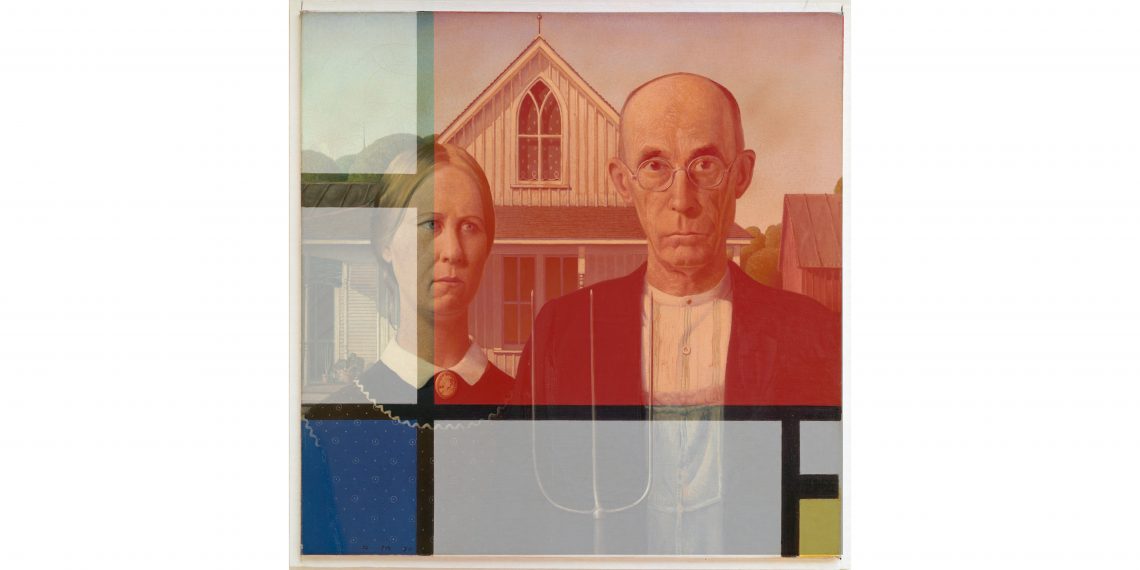
The most famous artwork from 1930 entering the public domain is probably Piet Mondrian’s Composition with Red, Blue, and Yellow. That place would certainly have gone to Grant Wood’s American Gothic, but its copyright lapsed in 1958, so it’s already out there. Though the estate applied to renew in 1980, it was unsuccessful.
Interestingly, European copyright is automatic, lasting for 70 years after the artist’s death. So in a reversal of the normal order, American Gothic was in the public domain in the United States long before its entry into the European public domain.
Film
The films from this year come from the time just beyond the talkie revolution. Bing Crosby appears for the first time on film in John Murray Anderson’s King of Jazz, and Jean Harlow makes her debut in Howard Hughes’s groundbreaking Hell’s Angels. Two Academy Award winners for best picture are here because the 1931 winner was copyrighted in 1930 — Wesley Ruggles’s Cimarron. Joining it in the public domain is a film featured on many all-time best-of lists, Lewis Milestone’s adaptation of Erich Maria Remarque’s All Quiet on the Western Front.
The controversial surealist film L’Âge d’Or, penned by Luis Buñuel and Salvador Dalí also appears. But if you want lighter fare, consider Soup to Nuts, written by Rube Goldberg (yes, he was a real person) and featuring later members of The Three Stooges.
Of course, this is only a small sample of the many, many works of human thought and imagination that date from the year 1930.
We’ll leave you with this gift of a remixed version of one of this year’s titles, The Little Engine That Could. With apologies to Ms. Lenski’s fine illustrations, we’ve hidden some gems from 2022’s Public Domain Day release, E.H. Shepherd’s illustrations of Winnie the Pooh. Pooh himself makes an appearance on each page, in the style of Goldbug from Richard Scarry’s Cars and Trucks and Things that Go (a book we’ll have to wait another forty years to see in the public domain unless the laws change).
Happy Public Domain Day!
Header Image: Franco-American Gothic (2026), remixed from Piet Mondrian’s Composition with Red, Blue, and Yellow and Grant Wood’s American Gothic (both now in the Public Domain)