Interview by Jonathan Peasley
Jonathan Peasley recently sat down with actor and director Josh David Jordan in Downtown Minneapolis for a conversation about Jordan’s second feature film, El Tonto Por Cristo, while he was in Minnesota to screen it at the historic Heights Theater. El Tonto Por Cristo (translation: “The Fool for Christ”) is a story about a group of monks at a fictional Eastern Orthodox monastery on the Texas coast. At the time of its production, Jordan’s film is the first feature-length, fictional American film with an Eastern Orthodox setting.
Jonathan Peasley: Tell the story about how you switched from acting to filmmaking? How did you wind up even making a film?
Josh David Jordan: I started out acting. My dad was a traveling evangelist. Still is. So late 80s, early 90s, if you’re not in California or New York, you’re not really in film school. And there was no online stuff. So the closest I could get was acting. And I would do that at church camps, summer camps, Christmas plays. I’m pretty sure I was a shepherd a bunch of times, or Joseph. I never got the Jesus role. I think it was my ginger hair.
Fast forward. I moved to Dallas, Texas, and there was this place called KD Acting Studio. It was kind of a bridge to be able to make something, shoot something, cast something in the Dallas-Fort Worth Metroplex. I’m still a part of the Ochre House Theater. I’ve been there for like fifteen years. Matthew Posey, who plays Father John in El Tonto Por Cristo, is a pretty well-known actor. He was in No Country for Old Men, Magnificent Seven, True Stories. And he started this theater company.
Me and my wife were watching Netflix, and she’s like, “What are you looking for?” I was like, “Well, I’m looking for a country Western singer-songwriter movie, but not like Crazy Heart, not the guy who falls from grace or the young kid from the country who makes it.” I was like, “What about the guy who doesn’t make it? He’s forty years old, and he wakes up one day, and he’s still playing the same bars. Where’s that movie?” And she goes, “Well, maybe you should just make it.”
And yes, that was like film school times a thousand. But in the end, I had a film. I had my first film, which is what everyone wants to see before they invest in your second film. Then I was trying to find something (again), and Jess is like, “What are you trying to find?” And I’m like, “I want an arthouse-style Orthodox movie.” That’s a niche of a niche of a niche. She just looked at me, and I was like, “Yeah, we’re gonna have to make it.”
Now here we are, sitting in Minnesota, and we’re premiering El Tonto Por Cristo — an arthouse, black and white, Orthodox film that I’m excited for the world to see. We just had our European premiere in Romania, and then Greece. The feedback has been crazy. I really do think that this is a foreign film to them, because for them Orthodoxy is just a way of life. It’s church and state. There’s an Orthodox chapel or church on every corner. For us Americans, it’s not the case. So for them to see this strange tale of Texan Orthodoxy has really sparked an interest.
I was wondering about that, whether maybe you knew going into it that the film might be too European for Americans and too American for Europeans. But say a little bit more about some of the reactions you had in Greece and Romania. What do you notice is different about the reactions compared to the American audiences that you’ve shown to?
Yeah, it’s been so wild. We had the world premiere in Texas at my favorite theater, called the Texas Theater. It’s historical. That’s where they found Lee Harvey Oswald after he had “assassinated” John F. Kennedy. I do quotations because, you know, people still talk about it.
We’ll do a follow-up interview on that. [laughs]
[Laughs] Yeah, we’ll do a conversation about that. The theater’s 650 people. It was about a 40-60 split of Orthodox people and people who just love cinema, who wanted to go to the Texas Theater and see arthouse. That was wild. Then non-Orthodox people started writing reviews, and that’s what kicked off this whole tour.
It’s a serious film in a way, but there’s lots of comedy in it, you know? The people from Serbia, Romania, Russia, Italy, they were like, “What is this type of film that Americans are making?” I was confused. They were like, “This is like a new genre, a new era.” But now that I think about it, that’s why I couldn’t find it on Netflix. It didn’t exist. Sometimes that’s a scary thing because no one’s ever done it before, so it’s hard to get people’s attention. But I think once you do, it becomes something people can look to. I mean, that’s what we’re hoping for.
You mentioned there’s a lot of comedy in the film. It was about a decade ago when I discovered this book of sayings of the Desert Fathers, and I’m still reeling from taking that plunge. So I’m curious what the discovery of the Holy Fool was like for you, coming from an evangelical background where the Holy Fool is not really a feature?
I’m really drawn to quirkiness, strangeness. I think the most beautiful things in the world are those that are shattered, molded, and put back together again as human beings. The wild is really attractive to me. I started reading the Desert Fathers, and there’s just so many saints that lived and slept in trees. This made sense to me. I felt strangely comforted knowing that there’s people that think a little bit abstract. They think wild. They think crazy. Really, the strangest people always created the best art. So for me to find these people who were just as strange but were also fools for Christ and their whole life was dedicated to that — it’s the best of both worlds for me. I got these wacko people who go off into the desert because they’re trying to be so close to God. They’re trying to be Christ-like. That was something I had to explore. I was just devouring it. And with all the devouring, I wanted to turn it into something not biographical. I do want to do those kinds of films; but for this one I just wanted to make a narrative arthouse film. The tapestry was Orthodoxy, but I wasn’t concerned about history or politics or anything like that.
I think this could be its own tangential conversation, but I think for me the Holy Fool was this realization that I can live with contradiction or that contradiction has a place in the experience and the life of a Christian, rather than how I grew up with this sense that I was always at odds with what I was supposed to be, how I was supposed to talk and behave.
Yeah, it’s like you’re struggling against nature, right? It seems like you’re doing something wrong, even though it feels natural and right. But in church they would just say, “Those things are wrong. You need to get counseling,” or “You’re sinning,” or all these things. And then I’m hearing these tales of holy fools and saints who would sit on the steps of a church eating sausage before divine liturgy and acting like a fool. It was like the parables, right? It’s how Christ talked. It’s how these people lived. And that was so exciting to me, to be able to feel like you’ve been rooting for the home team that you didn’t know was there.
I was just on Mount Athos, and a lot of times the different fathers would say, “I’m just a stupid monk who’s trying to do his best.” It’s five hours of service in the morning and five hours at night. There’s work in between, and then there’s sleep. These guys have the craziest stories. I think sometimes, especially maybe as Americans, we don’t concern ourselves with any of those things. We just concern ourselves with Christ. The film is just the tip of the iceberg. El Tonto Por Cristo is just a little appetizer of the fullness of Orthodoxy and the stories that I think we can tell. And I think it’s time that we start telling things cinematically.
Could you describe the work you did with priests and monks in the Orthodox Church while making the film? What were those interactions like, and what did you want or need from them? Did you have any moments where you felt like you had to restrain yourself in certain ways in order to meet their expectations?
That was probably the biggest roadblock for me, and that was not even a roadblock. It was unnecessary to wonder, “Am I Orthodox enough? I have only been Orthodox for twelve years. Am I Orthodox enough to make this? Am I being pious enough? Am I being true to the Orthodox Church?” I remember asking the bishop, “Is it OK that we’re filming here late at night in the cathedral?” He said, “Josh, as long as there’s not a murder at the end of the film that takes place inside the cathedral, you can do whatever you want.”
You know, this is art. This is cinema. And a lot of these priests are very artistic. They’re very well read. They’ve gone to art school and seminaries. They love poetry. And they love cinema. So they’re just as excited as I am. But I think, in their eyes, they want me to just go for it. “If anyone can go for it, it’s you.” The biggest cheerleaders so far have been Orthodox priests. They’re humans who love beauty. I was afraid I was going to offend someone, but to see their faces light up after watching this film …
I took the film all the way to the Metropolitan of America and Canada, Metropolitan Tikhon, and I remember him saying, “Josh, I was an abbot for 18 years at a monastery…” And I was thinking, uh-oh, here we go. But he said, “You nailed the monastery scenes.” He described how some monks are there forever, but others leave after two days. He says, “It’s just like the world, but it’s a safe place.” And he couldn’t believe how funny the movie was.
But another thing the Metropolitan said was, “Yes, let this film be blessed, but I can’t protect you from some of the zealots or people who look at Orthodoxy in a different light and say, ‘That’s not my Orthodoxy.’” He was right — there has been a lot of that. But it’s been eye-opening, and it’s been okay for me. When you create anything that’s art you’re gonna have people who don’t like it. I think it was Quentin Tarantino who said you want half the people to like your stuff and the other half to not like it. Because that way, you know you’re not just catering. I didn’t feel like we ever catered or made everyone feel hunky-dory or feel like this is a safe film.
I think it was Jonathan Pageau who said, “This is not an Orthodox movie. This is just cinema.” I mean, it is Orthodox, obviously. But it was nice to hear those things. So I think the biggest hurdle for me was to get out of my way and be like, “I’m just making a film where Orthodoxy is the tapestry. It’s just art.”
When I think of Orthodox film, I tend to think of Tarkovsky. Which is also strange at the same time because aside from Andre Rublev, the other films aren’t overtly Orthodox. He was this master of being an Orthodox filmmaker without being a literal Orthodox filmmaker. He left the Soviet Union for the last two, Nostalgia and The Sacrifice because he didn’t think he could get away with making the kind of film he wanted to make; yet, those aren’t explicit Orthodox films at all. So I’m wondering, where do you see yourself going from here? You mentioned a project you’re working on right now about St. John of Shanghai and San Francisco. But do you see yourself continuing to make movies where Orthodoxy is subtext, or are you trying to find more places where it’s the setting, it’s also on the surface?
When you hear about a Christian film, especially nowadays, it could be a little cringeworthy, you know? And it probably doesn’t hold up or stand the test of time. So that’s become a negative connotation, unfortunately. I was really sensitive to that, being an Orthodox filmmaker. But that’s the beauty of Orthodoxy. I’m Orthodox. I’m a filmmaker. I don’t think that I’m necessarily an “Orthodox filmmaker” in the sense of making propaganda. But the beauty of Orthodoxy is gonna shine through, like with Tarkovsky. You see these moments in Nostalgia. You see icons. You see someone’s life. And there are moments where you see someone maybe mumbling the Jesus prayer. Those are all things. Those are all real-life. And that’s the beautiful part. I want to continue to make true cinema that comes from me. So I think it’ll involve Orthodoxy. It will involve those types of things. Where I am at in my life, I can’t imagine making a film and there not be some aspect of Orthodoxy in there.
But it’s new. It’s strange because you don’t want to commercialize it. You just want it to be true. And it’s been really hard even getting the word out. If this was just a Christian film, I think it would be a lot easier to get the message out. But because the Orthodox Church fortunately moves so slow with anything, especially anything new, it’s like, well, let’s just tap the brakes. That’s the beauty of it.
I think what’s happened, though, is that it has been a natural advertisement for itself. On Mount Athos, I was coming out of the gift shop at one of the monasteries, this guy goes, “Oh, you’re American? Where are you from?” I said, “I’m from Texas.” And he goes, “Oh, man, there’s this movie coming out, and it’s made in Texas. You should check it out. It’s called El Tonto Por Cristo.” So like four people on Mount Athos knew about El Tonto Per Cristo in a matter of seconds because of this natural, organic sharing that’s going on. It’s like Orthodoxy. It’s the slow burn.
My boat broke down on Mount Athos. I was supposed to be going to Thessaloniki, catching a train, then a van, and then going to Romania. So it was tight for time. And one of the monks came up to the table and said, “Your boat motor’s broken.” I was thinking, “Oh my goodness, how am I getting off this island…” Then as I was walking, Father Adrianos asked, “Are you packed?” I said, “Yes.” He goes, “Grab your things. There’s a van. It’s just five euros. Some Romanian guys are taking the icon of the Holy Theotokos on a 30-minute speedboat. It’s your birthday today, so they’re taking care of you, and they have beer on the boat.” So I was literally riding back with beer and this four-foot icon of the Theotokos, going ninety miles an hour in a speedboat. Let’s just say I got back way before the van ever needed to leave. Before my visit, that would have been pure chaos for me, you know, all the problems of being a human. “Oh, of course, this is all happening to me. I have the worst luck.” But on Mount Athos, there are no problems. Things work themselves out. And that’s the beautiful part of it — the mystery of it all is that we don’t have definitive answers.
To bring it full circle back to the movie, a lot of people who watch the film love it because it doesn’t give you all the answers. There’s mystery, and some people can’t stand it because there’s no answers. I think that’s when Orthodox people really get excited about this movie, because we do understand the mystery of it all.
It seems like art’s really powerful when it brings the audience into the artist’s own experience of uncertainty. And to tie it back to something you mentioned earlier, it seems like theatrical showings have shifted since the pandemic, and they’re churning out “Christian” films right now. And those tend to pander. They provide a very safe, comfortable amount of certainty. And part of me is wondering, is that one of the things in being an Orthodox filmmaker that’s on the table for you that might not be to others? You’re part of something that doesn’t say at the end of the day, well, here’s all the answers. Instead it’s this tradition with the Holy Fool that’s really about freedom and differentiation from one person to another. I didn’t hear you mention David Lynch in your other interviews, but I almost think of him as kind of a secular yet holy fool of Hollywood. For example, when he had a cow out on the street trying to promote Laura Dern’s performance in Inland Empire, and everybody was like, “It’s just Lynch being Lynch.” But he kind of carved out this space to pursue an artistic vision that is divisive and so particular. So do you kind of see what you want to do as distinguished from mainstream “Christian” cinema in that regard?
A good example would probably be Terrence Malick’s The Tree of Life. I remember I was watching that film for the first time in a theater, and I was just crying. But these two older ladies were talking back and forth saying, “Let’s get out of here, Helen. This is no Brad Pitt film.” I thought, “Oh, it’s unfortunate that they came here to watch a Brad Pitt movie and not watch true cinema and true art.” And Malick provided all of that, you know. And that film never grows old to me.
I do think it’s time as Orthodox for us to be more Lynchian, instead of Kirk Cameron-y, to just let the world wonder. I think when you do that, it’s like when someone walks through an Orthodox Church. They’re moved by the beauty, and they’re moved by the divine liturgy. They’re not really sure what’s going on, but it changes them in a way. It gets their thought process going. I think we’ve done our part as Orthodox artists if we provide just a glimpse like that. I didn’t know anything about Orthodoxy, and I wish I would have learned about it through cinema.
I think the most important thing is to treat your audience or treat the people who are going to be participating in your art like they’re a lot wiser than you. No kid wants to be pandered to. You know, if you let a kid eat Fruity Pebbles every day for breakfast, they’re going to. But when you make them a nice omelet, and you show them how to make an omelet, I think it changes their life. And they respect you a lot more. Hopefully, that’s what we’re doing. I think there’s a lot of pressure on Orthodox artists to start putting true beauty out into the world and let people judge it.
And that also opens up the bigger risk for the artist, right? If you’re not going to pander to them, if you’re not going to preach at them, if you’re not going to make propaganda, you’re taking a risk of rejection. Could you describe what kind of rejection you got while making the film? And at what point were you OK with that?
Yeah, it was pretty lonely. It hadn’t really been done before. And I think that I was longing for the acceptance, the camaraderie of Orthodox priests. I certainly had that locally, but I had thought, “Man, people are gonna come out of the woodwork on this one.” It wasn’t that in the beginning. It was very lonely. Then in the art world, if you say “Lord Jesus Christ, Son of God, have mercy upon me a sinner” about twenty times in the first thirty minutes of a film, it will cause a lot of people to be uncomfortable. So I almost felt as if I had alienated myself. I hadn’t. That was just in my head. But I had to realize that I was just a vessel for this film, and that I couldn’t take too much credit or too much criticism. I just had to put it out in the world. It had to be created. It had to be done. And when you know, “Okay, this has to be done; it has to be made; and I’m the person who’s supposed to do it,” it feels a little bit easier to swallow. I knew over time that people would find the movie. And I’ve always wanted to create art like that.
It’s not very good when I tell my wife that. She gets nervous because of the commerce aspect. “I hope one day this kid in Germany pulls this off a shelf and watches it and loves it and wants to know who Josh David Jordan is.” That’s hard to think about. But I think if you just wanted to make this movie because you wanted to watch it (and it’s wild because out of all the things I’ve created, in my entire life, I can sit and watch this film and find something new, find an Easter egg, find something subconscious that I’ve never seen before) that’s when you know you’re making the right stuff. You’re making true art. And if you really think about it and dwell on it, yeah, there’ll be some vanity in there. This film is borderline pretentious. I mean, how could it not be? It’s a black and white, European-style, Orthodox movie about a holy fool. That’s a nice tightrope to walk. But I think we pulled it off as a creative team. The actors, the composers, and everybody involved, I think they pulled it off.
You know, you’re describing the loneliness, but also sticking with your vision, your intuition. I mean, did it occur to you that you’d become a kind of Holy Fool yourself by making the film?
I think the film is a holy fool in this weird way. It’s the film that’s causing people to judge it. They say, “That’s not correct Orthodoxy, that’s not what Christ would want.” But then it sinks in a little bit, and you begin to ponder, and it becomes a mirror (which is wild, because there are lots of mirrors in the film). That just made sense to me. The film’s like a mirror. It’s a film for me to look at myself at times and be like, “Oh, what am I doing?”
I love that connection you made because you actually put some language to that. That’s kind of how the Holy Fool, at least in Russian society, is understood. The reason he might behave in an offensive way is to tempt your pride.
Yes, you’re ready to judge him.
But, you know, what is his sin to you? And so there is a kind of a mirroring effect of the Holy Fool role.
Yes. I like that. I like that connection. There’s a lot of it in the film. I’m just now realizing there are lots of mirrors in the movie. Hopefully, this film is the film that makes all the great Orthodox films come out. I hope it’s a catalyst.
The novel Laurus by Vodolazkin has that awesome line when he’s with the Holy Fool who says to him, “You’ve renounced your body, but that will make you prideful. The next is to renounce your identity.” And that’s just such a powerful moment. I feel like the arts are required to depict this renunciation of self, because it’s easy for catechumens, speaking of my own journey here, to think that it’s all done once you’ve learned the bodily rigor of Orthodox practice. Fasting and standing for long services is relatively easy because it’s concrete, but it’s hard to picture what’s on the other side or where this is supposed to lead us.
It’s like being on Mount Athos. New catechumens or converts, we almost want to take the joy out of everything. We want to be so rigorous. It needs to be miserable. But on Mount Athos — seeing what they do, their rigor — it’s how much joy it brings them. Their eyes are sparkling, and they’re telling me jokes, but they’re also constantly praying. They’ve given up so much, but the rigor has become more joy than they could ever imagine. And you feel it. I love moments of reversal. Reversing of expectations. And I found that to be true there.
Say more about how you really wanted to make an American Orthodox film, and how that hadn’t really been done.
I mean, for me, I’ve been writing Marfa, Texas — a Serbian Orthodox vampire story. I have all the lookbooks, and I was like, “I think I’m writing an Orthodox Lost Boys.” It’s okay. Let it be so. It’s always been the Catholic church with The Exorcist and all these things. But it’s cool to now be able to write these Orthodox tales. A lot of these are real stories, but it’s an Orthodox background.
Did you feel like, as a filmmaker, and with other ideas in mind, did you have things that you walked away from where you’re like, all right, I figured out how to do this, and now I got this moving forward? Or on the other side, did you have some moments where you’re like, all right, now I know what not to do while making a film?
Oh, all of the above. I think Rod Howard said no matter how good your film is or how bad it is, it’s always guaranteed to break your heart. I always learn so much, but I also learn that I do know a lot. When you’ve made one feature film, people look at you like, “Well, he got lucky.” If you do two, well, “You survived.” Three is around the corner. I look at people like Paul Thomas Anderson, and I’m like, “Ah, he’s making these films at twenty-six and twenty-eight, and here I am in my forties!”
But so was Robert Altman. He made his first film when he was forty-one, and I find comfort in that. I’m writing my own story. At the end of the day, it’s just one foot in front of the other. You look back, and you’ve learned so much from these other films. You can be proud of them, but you can also be a little cringe at times. That’s how you learn. It’s touching the hot stove. But I think I’ve touched enough hot stoves to make some nice dishes these days, and I’m really excited about it. I have confidence in what lies ahead.
Interested in knowing more about the project, keeping up to date with releases, or even working to bring a showing of El Tonto Por Christo to an arthouse theater near you? Click Here to visit website.
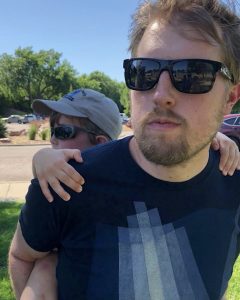
Jonathan Peasley teaches high school literature and lives with his family in St. Paul, Minnesota, where he loves exploring the rivers, lakes, and trails via bike, ski, and ice fishing tent.
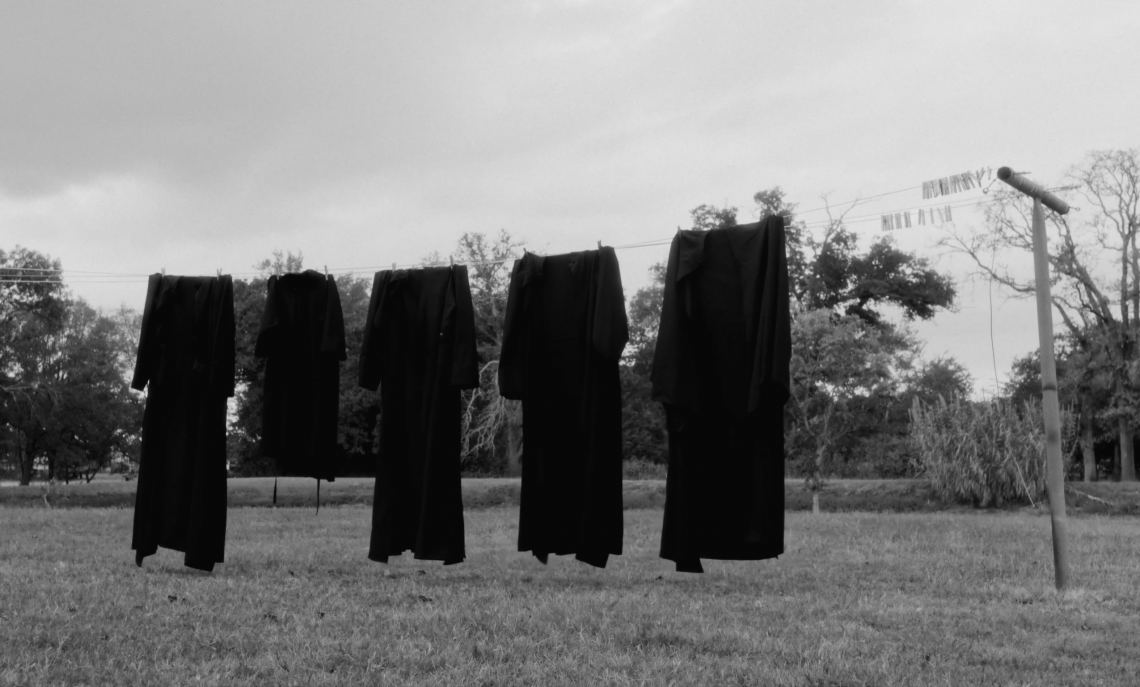
header image: Still Image from El Tonto Por Christo (2025)